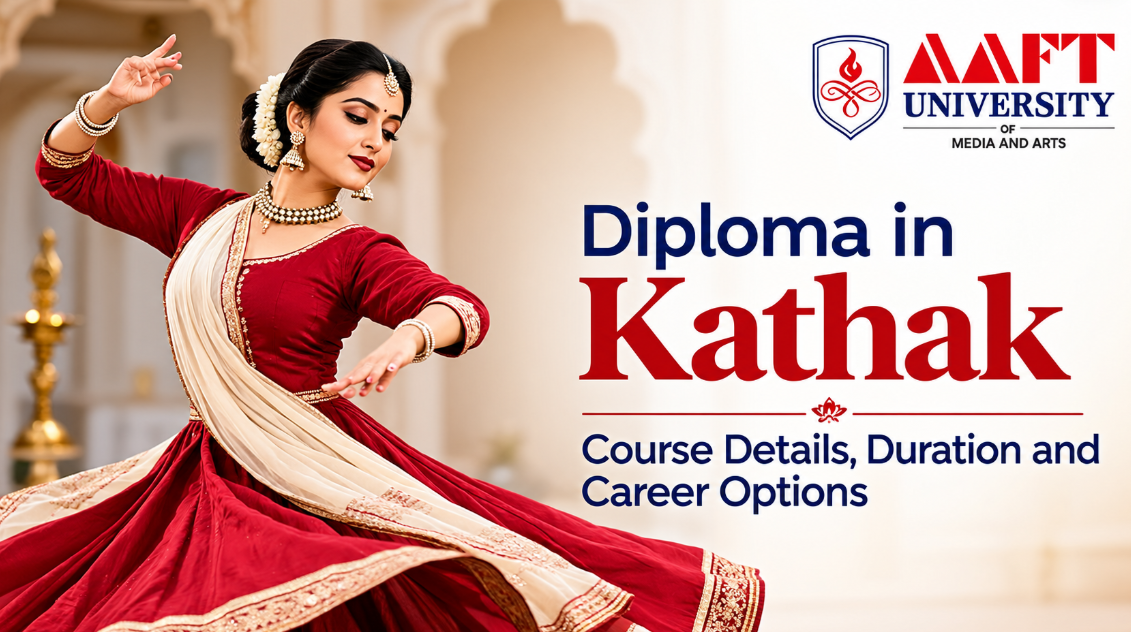
A diploma in Kathak is a structured, certificate-level program that trains you in one of India’s eight classical dance forms, from basic footwork to full stage performance. Most diplomas run for one year, cover both practical training and theory, and open doors to careers as a performer, choreographer or dance teacher.
This guide covers the course details, duration, syllabus, eligibility, career paths and earning potential, so you can decide whether the course fits your goals.
What Is Kathak? A Short History of the Classical Dance Form
Kathak is a classical dance form from North India. Its name comes from the Sanskrit word katha, meaning story, and it began with travelling storytellers called kathakars. They narrated mythological tales through gesture, expression and rhythm in temples and village courtyards.
The form changed over the centuries. Under Mughal patronage it moved into royal courts, where it picked up Persian influences, faster rhythmic play and a more refined, graceful style. Today Kathak combines three strands:
-
Nritta: pure dance, built on rhythm, footwork and spins.
-
Nritya: expressive dance that interprets poetry or music through emotion.
-
Natya: dramatic storytelling through movement.
Kathak is known for quick footwork, graceful spins (chakkars), subtle facial expressions and a close relationship with the tabla and other percussion. The ghungroo, the bells tied around the ankles, make every step audible, which is why rhythm is the heart of this art form.
What Is a Diploma in Kathak?
A diploma in Kathak is a short-term, skill-focused programme that teaches classical Kathak in a systematic way. It suits people who want formal training without committing to a full degree. You build technique step by step, learn the theory behind the art and practise performing in front of an audience.
The course usually works for several kinds of learners:
-
Beginners who want to learn Kathak from scratch.
-
Hobbyist dancers who want a proper foundation.
-
Students who plan to pursue a bachelor’s degree in performing arts later.
-
Aspiring dance teachers and choreographers.
Diploma in Kathak Course Details
Duration and Course Levels
The duration of a diploma in Kathak depends on the institution. Many university diploma programs run for one year, divided into two semesters. Some music and dance academies offer longer, multi-year certificate pathways instead.
Levels typically move from basic to advanced:
-
Foundation: posture, basic hand and foot movements, and simple rhythm cycles.
-
Intermediate: longer compositions, spins, more complex taal patterns and basic expression.
-
Advanced: full performance pieces, improvisation, choreography and stagecraft.
A one-year diploma generally compresses these levels, which makes it a good fit for focused, practice-heavy learning.
Graded Kathak Exams vs University Diploma Programs
Students often confuse graded exams with university diplomas, and the two are different routes.
Graded Kathak exams are conducted by music and dance bodies at set levels, such as the initial, intermediate and advanced stages. You prepare at your own pace, often at a local academy, and sit exams at intervals. They suit people who learn part-time alongside school or work.
University diploma programs are full-time, institution-run courses with a fixed syllabus, semesters, faculty guidance, internal assessments and stage showcases. They combine training with campus exposure, workshops and peer learning, which makes them better for people who want to build a career in dance.
If your goal is a profession, a university diploma gives more structure, performance opportunities and a clearer progression to higher study.
What You Learn: Tatkar, Chakkars, Abhinaya, Taal and Laya
The practical side of the diploma builds the core skills of Kathak:
-
Tatkar: the foundational footwork of Kathak, performed at varying speeds. Mastering tatkar builds the control and clarity that every other element depends on.
-
Chakkars: the signature spins, practised with balance, speed and precision.
-
Abhinaya: the art of expression through the eyes, face and gesture. It lets a dancer convey a story or emotion without words.
-
Taal: the rhythmic cycle that structures the dance. Common cycles include Teentaal, Rupak, Jhaptaal and Dadra.
-
Laya: tempo, or the speed at which rhythm moves. Dancers learn to shift smoothly between slow, medium and fast tempos.
-
Hasta mudras: hand gestures, both single-hand (asamyukta) and double-hand (samyukta), used to express objects, emotions and ideas.
-
Toda, tukda and gat nikas: short rhythmic compositions and graceful walking patterns that form the building blocks of a recital.
Theory: Gharanas, Music and Dance History
A good diploma in Kathak is more than practice. Theory helps you understand what you perform. Common topics include:
-
Gharanas: Kathak has distinct stylistic traditions, mainly the Jaipur, Lucknow and Banaras gharanas. Each differs in emphasis. Jaipur is known for intricate rhythm and footwork, Lucknow for grace and expression, and Banaras for its own refined technique.
-
Music basics: understanding taal, bol (the syllables recited in rhythm) and how dancers work with tabla and vocal accompaniment.
-
Dance history: the evolution of Kathak and the contributions of renowned exponents.
-
Terminology: the language of classical dance, such as padhant (reciting bols), ras (aesthetic emotion) and thaat (the opening pose and movement).
Eligibility and Admission
Eligibility varies by institution, so always check the official programme page before you apply. In general, diploma-level dance courses are open to learners who have completed secondary or senior secondary school. Prior training is usually not mandatory, since many programmes teach from the foundation level, though a passion for dance and basic rhythm sense help.
Admission often follows a simple process:
-
Fill in the application form.
-
Take an entrance test or assessment, if the institution requires one.
-
Attend a personal interview.
-
Receive admission confirmation and complete enrolment.
For tuition and installment details, always refer to the official fee structure page of the institution instead of third-party sources, since fees are revised from time to time.
Learning Kathak Through AAFT’s Diploma in Dance
If you are looking for a university-based route, AAFT University in Raipur offers a Diploma in Dance with a one-year, two-semester structure. Kathak is a central part of its syllabus, alongside performance practice and creative dance formats.
Classical Dance Training and Practice
The syllabus follows a clear progression through the year.
Semester 1 builds the foundation. Students work on footwork and hand movements, dance exercises, single-hand mudras and the study of taals such as Teentaal, Rupak, Jhaptaal and Dadra Kaharwa. They also learn toda and tukda compositions of Kathak and begin working on bhava, or expression.
Semester 2 deepens technique. Students study varieties of tatkar, learn about renowned dance exponents and practise padhant of taal. They prepare taals such as Basant and Gaj Jhampa, learn double-hand mudras, thaat, ras, guru vandana, gat nikas and kavitta.
This structure moves from basic rhythm and gesture to refined compositions, which suits both complete beginners and those with some prior exposure.
Stage Performances and Showcases
Dance is learned by performing, and the programme builds in performance opportunities. Key takeaways listed for the course include presentations of Kathak and folk dance, a Bollywood dance fusion presentation, a mime show and free-style creative dance. This mix means you learn classical technique while also seeing how it adapts to contemporary and popular settings.
Students also get exposure through workshops led by leading professional dancers. The workshop line-up includes Guru Prerna Shrimali, Guru Saswati Sen, Padma Shri Guru Shovana Narayan and Guru Jayanti Mala Mishra. Learning alongside established gurus gives students a view of the profession that goes beyond the classroom. For the exact details of the current batch, check the official programme page.
Career Options After a Diploma in Kathak
A diploma in Kathak can lead to several career directions. Many dancers combine more than one role over time.
Performer and Soloist
Performing is the most direct path. Kathak artists perform at cultural festivals, temple and heritage events, corporate and government functions, television programmes and stage productions. Building a name as a soloist takes consistent practice, regular performances and a strong portfolio of recorded work. Many artists start with group performances and gradually move to solo recitals.
Choreographer for Stage, Films and Events
Choreographers design the movement for a performance. With Kathak training, you can choreograph classical pieces, fusion acts, dance dramas, wedding performances, film and music video sequences and event shows. The ability to blend classical vocabulary with modern styles is increasingly valuable, because audiences enjoy both tradition and fresh interpretation.
Dance Teacher and Academy Owner
Teaching is one of the most stable career routes. You can work as a dance instructor in schools, colleges, cultural centres and private academies. Many experienced dancers eventually open their own studios, run online classes or conduct workshops. Teaching also strengthens your own technique, because explaining a movement forces you to understand it deeply.
Further Study: Bachelor and Master of Performing Arts
A diploma can also be a stepping stone to higher education. Students often continue to a bachelor’s degree in performing arts, and later to a master’s, which deepen both practice and theory. Higher degrees are particularly useful if you want to teach at college level, pursue research in dance or take on academic and institutional roles.
Salary and Earning Potential for Kathak Artists
Earnings in Kathak vary widely and depend on how you build your career. There is no single fixed salary, so it is more useful to understand what influences your income:
-
Experience and reputation: established performers and gurus command higher fees than beginners.
-
Type of work: teaching roles often provide a steady monthly income, while performances and choreography are paid per project.
-
Location: metros and cultural hubs usually offer more opportunities and higher rates.
-
Skill diversification: dancers who teach, perform, choreograph and create online content tend to earn from several sources.
-
Visibility: a strong social media presence, recorded performances and a professional portfolio help attract bookings.
In the early years, many artists build income gradually through classes, small performances and assistant roles. Over time, as skill and reputation grow, earning potential increases through solo shows, choreography projects, workshops and running an academy.
Final Thoughts
A diploma in Kathak is a practical way to turn a love for classical dance into a skill and, eventually, a profession. It gives you disciplined training in rhythm, expression and performance, along with the theory that makes you a complete artist. Whether you want to perform on stage, choreograph, teach or continue to higher study, a structured diploma gives you a solid first step.