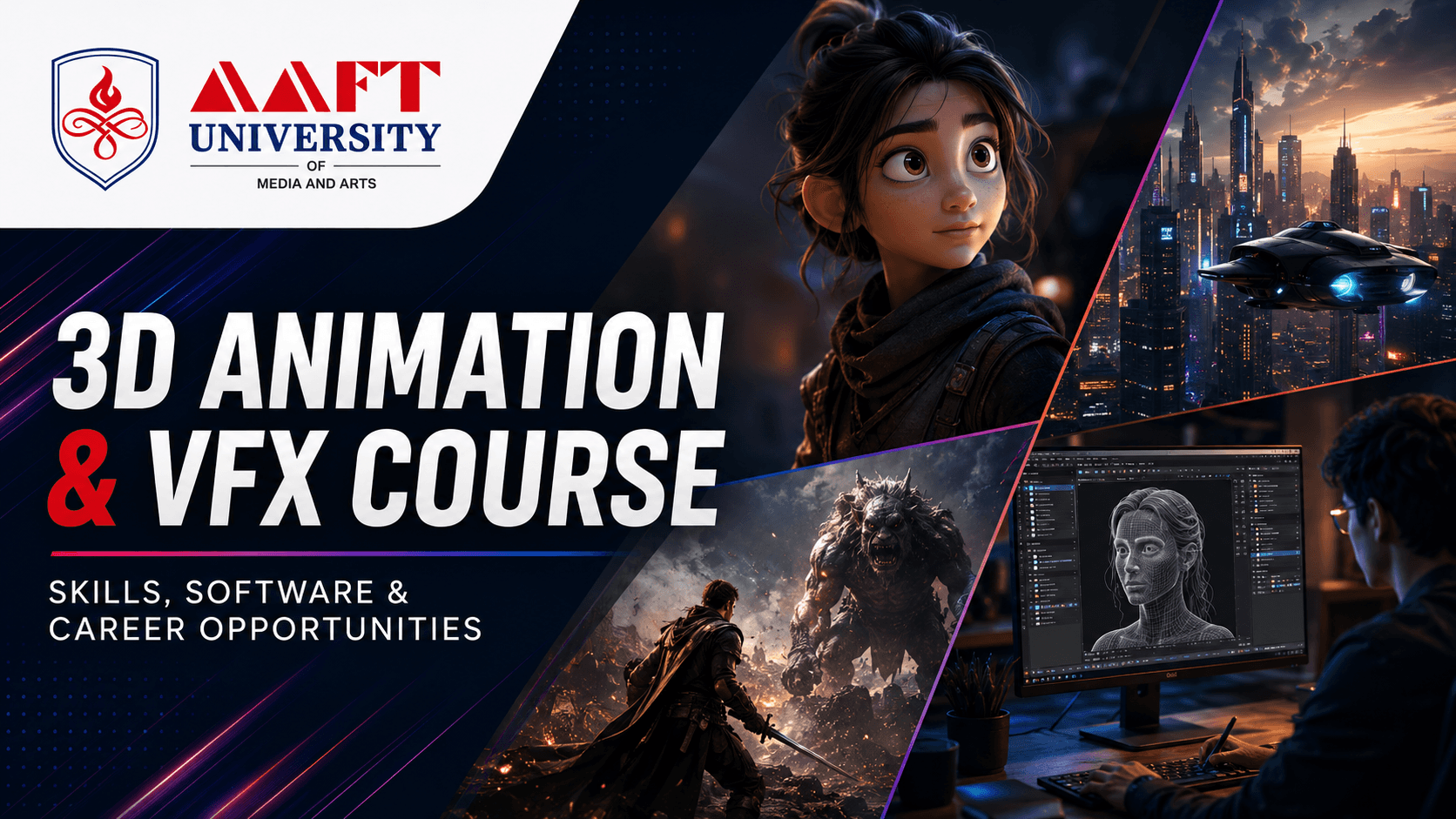
India’s animation and VFX industry is scaling fast, driven by OTT content, gaming, advertising, and global studios outsourcing post-production work to Indian talent. For students exploring a 3D Animation & VFX course in India, a structured degree programme can provide the technical skills and production experience needed to enter animation studios, gaming companies, and VFX houses. The right programme should cover the complete production pipeline, from 3D modelling and texturing to animation, compositing, and industry-standard software.
What is 3D Animation & VFX?
3D Animation is the process of creating movement in three-dimensional digital space, starting with modelling characters and environments, followed by rigging, animation, lighting, and rendering. VFX (Visual Effects) is the craft of blending computer-generated elements with live-action footage through compositing, simulation, and match-moving. Together, they power films, games, advertising, and streaming content.
3D animation starts with concept art and modelling, moves into texturing and rigging (building a digital skeleton so characters can move), and finishes with lighting and rendering. On the contrary, VFX work overlaps heavily but focuses on integrating digital elements into real-world footage that includes green-screen compositing, particle simulations for fire or water, and set extensions that would be too expensive or impossible to shoot practically.
The two disciplines have increasingly merged into a single production pipeline across studios. Today, artists are often expected to understand both 3D asset creation and compositing workflows, which is why a structured B.Sc. in Animation & VFX combines both disciplines rather than teaching them as separate specialisations.
BSc 3D Animation & VFX at AAFT University Raipur
AAFT Raipur's B.Sc. (3D Animation and VFX) is designed as a full degree programme rather than a short-term diploma, combining Unreal Engine-based real-time production training, a 15+ project portfolio across six semesters, and a curriculum aligned with the workflows used by modern VFX studios.
While institutes like MAAC and Arena Animation are known for diploma-style, software-focused training, AAFT Raipur takes a broader, degree-first approach. Its UGC-recognised B.Sc. (3D Animation and VFX), with a 4-year Honours option, is built around six learning pillars like teamwork, project management, creative decision-making, general awareness, problem-solving, and practical project-based learning. This structure is designed to prepare graduates for studio hiring processes, rather than focusing only on software training.
What sets the programme apart is its production-first pedagogy. Each semester is lab-based and project-driven, allowing students to apply the tools they learn to real project work and build a portfolio of 15+ production-quality outcomes before graduation. The curriculum integrates Unreal Engine and real-time virtual production, technologies increasingly used across modern filmmaking and game pipelines, alongside traditional VFX workflows such as match-moving, compositing, simulation, and cinematic rendering. This gives students exposure to both established and next-generation production methods.
The programme also promotes interdisciplinary collaboration, with animation and VFX students working alongside AAFT Raipur's film direction, cinematography, and game design departments to experience collaborative production environments. Combined with placement tie-ups with Digitoons, Inge Gaming, Aaj Tak, ITV Network, and Adloid, along with studio-grade infrastructure, the programme enables students to graduate with both a recognised degree and a portfolio aligned with industry expectations. Detailed fee information, including installment options, is available on AAFT Raipur's official fee structure page.
Subjects & Curriculum
The B.Sc.animation course runs across six semesters, with the Honours track extending to eight semesters. The curriculum progresses from foundational design and animation skills to advanced 3D, VFX, compositing, and real-time production:
- Semester I–II: Students build their foundation in Design & Construction, Vector Illustration, Digital Image Editing, Pre-production, 2D Animation, and Audio-Video Editing.
- Semester III: The focus shifts to 3D production, covering Modelling and Texturing, Lighting & Rendering, Rigging and Animation in 3ds Max, along with Simulation and Effects.
- Semester IV: Students advance into organic and inorganic modelling, texturing, lighting, rigging, and dynamics simulation using Maya, alongside Acting for Animation and Motion Graphics.
- Semester V: The curriculum moves into advanced VFX, covering Houdini, node-based compositing, rotoscopy, set extension, Nuke compositing, and matte painting.
- Semester VI: Students work on advanced compositing, 3D asset design in Blender, MotionBuilder and HumanIK in Maya, animatics, storyboarding, and an industry internship, bringing together the skills developed throughout the programme.
Students pursuing the Honours track continue into Semesters VII–VIII, with advanced sculpting in Blender and ZBrush, live scene setup in Unreal Engine, art direction, and advanced texturing in Quixel. These additional areas provide deeper exposure to specialised VFX and real-time production workflows, supporting progression towards roles such as VFX supervisor, technical artist, and other advanced production positions.
Software Covered
A well-rounded Maya Blender course India students should look for covers the complete pipeline: Autodesk Maya and 3Ds Max for modelling and animation, Blender and ZBrush for sculpting, Houdini for simulation, Nuke for compositing, and Unreal Engine for real-time rendering.
AAFT Raipur's program covers this exact stack, plus supporting tools like After Effects, Photoshop, Illustrator, and Premiere Pro. Maya and 3Ds Max form the backbone of character modelling, rigging, and animation training in Semesters III and IV. Blender is introduced for 3D asset design and later returns for advanced digital sculpting alongside ZBrush in the Honours track.
Houdini and Nuke handle the VFX-specific side: simulation effects and node-based compositing, while After Effects is used for rotoscoping and motion graphics work. This breadth matters because studios rarely hire someone who knows only one tool; a rigger who can also composite, or a modeller who understands Unreal Engine's real-time pipeline, is far more employable.
Career Options After 3D Animation Course
Graduates of a 3D animation VFX course in India can work as 2D/3D Animators, VFX Artists, Compositors, Riggers, Texturing & Lighting Artists, Storyboard Artists, or Motion Graphic Designers, across film studios, game developers, advertising agencies, and OTT production houses.
The career map for animation and VFX graduates has widened well beyond traditional cartoon studios. Job roles now include 3D Assets Developer, Illustrator, Video Editor, and Motion Graphic Artist, spanning industries as varied as gaming, architectural visualisation, advertising, and streaming platforms. VFX India demand specifically has grown as global studios route compositing, rotoscopy, and simulation work to Indian VFX houses, drawing on the country's large pool of trained artists.
AAFT Raipur's placement network reflects this spread, with tie-ups including Digitoons, Inge Gaming, Aaj Tak, ITV Network, and Adloid, giving students direct exposure to studio hiring processes across animation, gaming, and broadcast media. A strong showreel built from the 15+ production-quality projects most structured programmes require before graduation tends to matter more to recruiters than the degree title alone, so continuous portfolio work throughout the course is essential.
Freelance and remote opportunities have also expanded this 3D animation career path considerably. International studios increasingly hire Indian artists on contract for specific VFX shots or animation sequences, which means graduates aren't limited to full-time studio roles in Mumbai, Bangalore, or Hyderabad, though these cities remain the strongest hubs for entry-level hiring density.
Salary in Animation Industry
Entry-level animators and VFX artists in India typically earn ₹2.5 to 4 lakh per annum (roughly ₹20,000–33,000 a month). With 3 to 6 years of experience, this rises to ₹4 to 10 lakh annually, and senior animators, VFX supervisors, or art directors with 7+ years can earn ₹10 to 30 lakh or more.
|
Experience Level |
Typical Annual Salary |
|
Fresher (0–1 yr) |
₹2.5 to 4 LPA |
|
Junior (1–3 yrs) |
₹4 to 6 LPA |
|
Mid-level (3–6 yrs) |
₹6 to 10 LPA |
|
Senior (7–10 yrs) |
₹10 to 18 LPA |
|
Lead / Art Director (10+ yrs) |
₹18 to 30 LPA+ |
Location plays a significant role in pay bands. Mumbai leads with the highest average packages, owing to its concentration of film studios, VFX houses, and advertising agencies, followed by Bangalore, Hyderabad, and Pune. Freelancers working with international clients often out-earn studio-based peers, with experienced freelance VFX artists reporting monthly rates well above equivalent in-house salaries.
Specialisation also drives pay artists with strong Houdini or Nuke skills for high-end VFX work generally command more than generalist 2D/3D animators, reflecting the technical depth required for simulation and compositing roles.
Frequently Asked Questions (FAQs)
What software is taught in BSc Animation & VFX?
A BSc in Animation & VFX typically covers Autodesk Maya, 3Ds Max, Blender, ZBrush, Houdini, Nuke, Unreal Engine, and After Effects spanning modelling, rigging, simulation, compositing, and real-time rendering across the full production pipeline.
What is the duration of the BSc course?
The BSc (3D Animation and VFX) is a 3-year degree programme, with an optional 4-year Honours track for students who want deeper specialisation in VFX supervision, art direction, or research-based study.
Is VFX a good career in India?
Yes. India's VFX industry is expanding as global studios outsource compositing, simulation, and rotoscopy work locally, creating steady demand for skilled artists across films, gaming, advertising, and OTT platforms.
What is the salary of an animator in India?
Fresher animators typically earn ₹2.5 to 4 lakh per annum. This grows to ₹4–10 lakh with 3–6 years of experience, and senior animators or VFX supervisors can earn ₹10–30 lakh or more annually.
Can I do BSc Animation after a science background?
Yes. Most BSc Animation & VFX programmes accept students from any 10+2 stream like science, commerce, or arts, since the course builds technical and creative skills from the ground up, without requiring prior design or coding experience.